
You know the feeling when you walk into a bookstore with the express purpose of buying the one book you came for, and you stumble out three hours later, carrying seventy-eight bags of books, completely parched, exhausted, and confused like…
Then you go back to your cozy little homeplace and add those books to a teetering tower of their unread compatriots that already poses a legitimate physical threat to your personal safety like…
Despite having bookshelves in almost every room of our house, I have those soon-to-topple towers all over the place, too. Frankly, that’s just the way I like it.
The “Jammed-in-a-blender” Aesthetic
As a writer of paranormal romance and urban fantasy, I spend my days wrangling wolves and swimming in enough emotional angst to power a small city. I’m building a universe where the stakes are cosmic, the romance is sweet & steamy, and the violence is (when necessary) cinematic and often gratuitous. By all rights, my TBR piles should probably be monoliths of genre consistency. That would make sense, wouldn’t it?
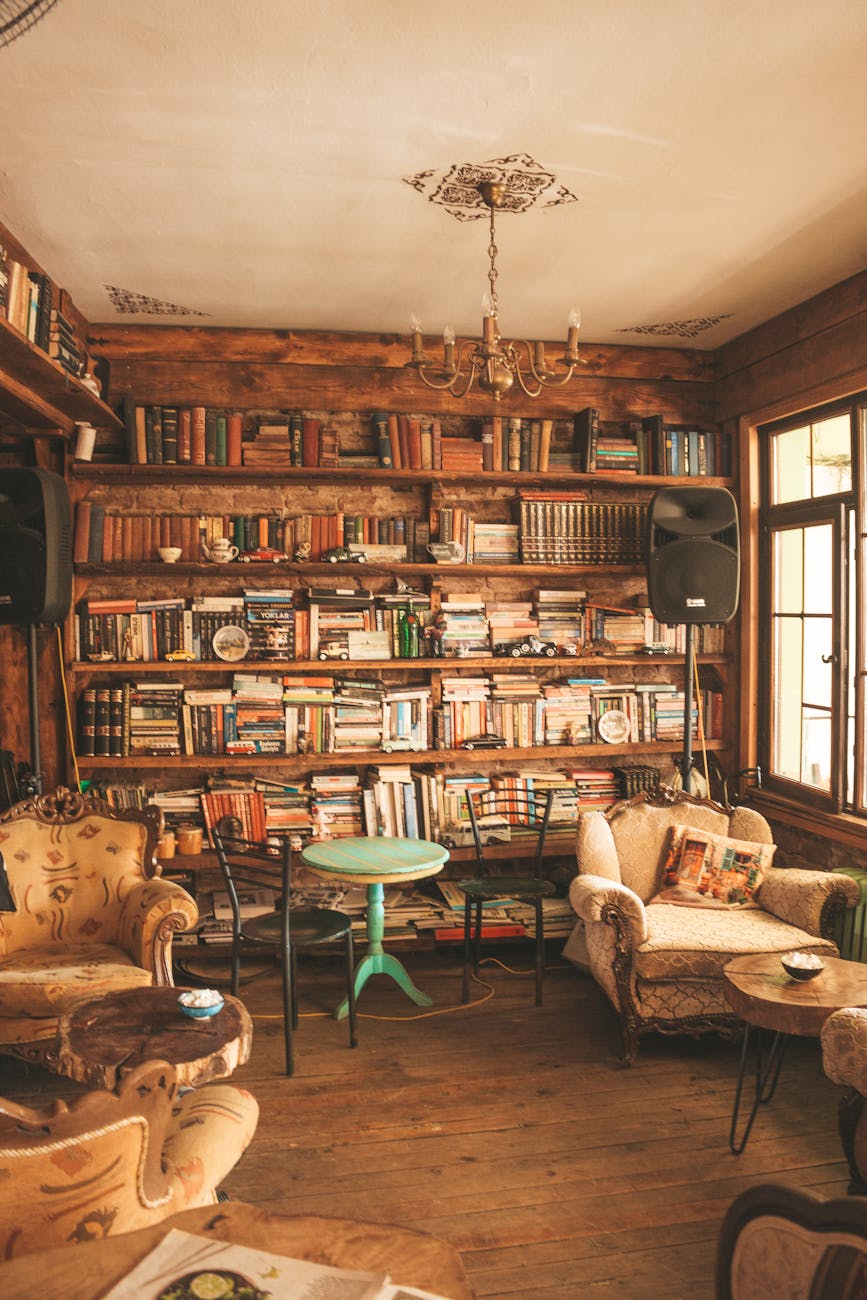
Yeah… no. Our house looks like a used bookstore got jammed in a blender.
If you were to audit my bookshelves right now (I mean, please don’t, for both our sakes), you’d find slasher horror novels perched precariously atop dense works of sociopolitical nonfiction, sandwiched between vintage erotica paperbacks and hardcover essay collections. Next to those, you’d find battered copies of classics we’ve read and re-read, followed by an indie romance that probably features a man on the cover who’s holding a chainsaw but also looks like he knows how to treat a gal right.
It is a mess. It is chaos. A structural hazard, no less. And I have, much more recently, come to the conclusion that this is exactly how it should be.
Can We Please Stop Curating Everything?
I feel like we’re kinda just coming out of a time of celebrating hyper-exacting standards. For so long, I’ve seen curated closets, aesthetic social media feeds, and attempts to make everything from meal prepping to packing to gardening feel pretty and glamorous. There’s been this uptight air about the key to happiness – you might find it in a minimalist aesthetic or the perfect capsule wardrobe or by carefully cultivating selections of books that align with your “personal brand”.
I am here to tell you: none of that makes me happy, especially when it comes to books.
The Compare-and-Despair Spiral
Part of the reason I began a social media hiatus in 2020 was that I’d fallen deep into the very weird and icky compare-and-despair trap. I came to believe that I would never go anywhere if my aesthetic wasn’t right. My pictures of books didn’t look like all the pretty ones I saw online. My feed wasn’t as pink or bright & airy or neutral blah as so-and-so’s. All of this clearly meant I would never gain any followers, which clearly meant I should give up, and I should clearly go ahead and hate myself for being inferior while I was at it.
I’m not hating on anyone who loves arranging and rearranging their book collections in beautiful ways. Every time I open Instagram and TikTok, I see loads of beautiful images and hilarious videos from folks who take great care in their content. I love that – for them.
As I’m coming back around to social media, what I’ve learned – for me – is that I need my book life to be untidy. I need the random piles and the nonsensically categorized shelves. A messy bookshelf is a sign to me that I am not afraid to feel. Feeling, in turn, is a sign of healing for me, after years of hard work (with many more to go) of therapy. Feeling means I’m not compartmentalizing, I’m not dissociating. I’m present and connected.
Umberto Eco’s Antilibrary
There’s this quote from Umberto Eco, regarding what he referred to as an “antilibrary”:
“It is foolish to think that you have to read all the books you buy, as it is foolish to criticize those who buy more books than they will ever be able to read. It would be like saying that you should use all the cutlery or glasses or screwdrivers or drill bits you bought before buying new ones.
“There are things in life that we need to always have plenty of supplies, even if we will only use a small portion.
“If, for example, we consider books as medicine, we understand that it is good to have many at home rather than a few: when you want to feel better, then you go to the ‘medicine closet’ and choose a book. Not a random one, but the right book for that moment. That’s why you should always have a nutrition choice!
“Those who buy only one book, read only that one and then get rid of it. They simply apply the consumer mentality to books, that is, they consider them a consumer product, a good. Those who love books know that a book is anything but a commodity.”
If you poke around the internet, you’ll find he’s not the only one to express such a concept. You may have come across the idea of Tsundoku (積ん読) online, which is also somewhat similar. And this vibe is where I’ve landed with our books, as well.
When I first started working at my last job, one of my coworkers attempted to embarrass me by bringing up my Amazon author page in a team lunch. It didn’t work because A) theatre kid, hello 👋 and B) as I told my teammates: My parents have read all my books. If that didn’t send me to an early grave, my coworkers knowing I write sex scenes definitely ain’t gonna do it.
Vampire Smut vs. The “Sad Girl” book
I love a naughty romp as much as the next person – probably more, if my Kindle history is to be believed (and it is). I will defend a good sex scene until I’m blue in the face. I write them, rather than cutting to a sexy discretion shot. I read them. I advocate for them. And I appreciate all the mechanics and the *emotional* release. There’s such comfort in the formula of romance and erotica novels. You know the journey. You know the destination. You know that, regardless of how many misunderstandings, bear fights, vampire slayings, or demon encounters stand in the way, there will be a Happily Ever After. Those books are my warmest blankets. Their tropes are my scrummiest mac and cheese.
But sometimes, you don’t want a warm blanket or mac and cheese. Sometimes, you need to feel your feels. You want to be stabbed in the heart. You want to faceplant in the snow and feel the cold. You want to know that the experiences you are facing are not singular to you. You may even want to read about someone who is having a worse time than you are, so you can feel less alone.
For me, that need calls up my guiltiest bookish pleasure: the sad girl book.
A Prescription for Pain
I’ve been thinking a lot about sad girl books lately. This is a genre designation that may not technically exist in the Library of Congress, and it’s got its issues for sure (many feature white characters of privilege who bemoan the first-worldiest of problems, for example). They’re the literary equivalent of lying on the floor in a dark room, during a thunderstorm, listening to Elliott Smith. And honestly? Forget vampire smut or dragon smut or wolf smut or even handsome sentient food smut when what I need is a sad girl book. Sad girl books, like all other books, have specific medicinal values.
When you have a headache, you might take ibuprofen. When you have a sprained ankle, you probably don’t chug cough syrup (I mean, I don’t know what you’re into; maybe it’s seeking out pink elephants to help you forget your aches and pains).
I’m done with lining up high fantasy epics on a shelf and forcing myself to choke them down because they’re prestigious. Maybe what I need is a deliciously trashy motorcycle club romance to chill out with after a long week. Sometimes, you need a chewable baby aspirin, and I’m finished feeling bad about that.
I also used to feel bad about buying new books when I had stacks of unread ones. Why, though? It’s not like the unread ones actually judge me when I bring home new book friends. And I used to give myself ridiculous, overly ambitious reading lists, which I shared publicly and stuck to, even if I didn’t need those books at that time. If I went off the list, I felt like I was cheating on my commitments. I felt like a fake, like I was somehow doing reading wrong.
Fuck that.
You buy a box of bandages before you get a cut, knowing you inevitably will. You buy the headache meds before the pain because you know the pain will come. You buy the sad girl book in July because you know there may be a bleak February ahead. You buy the 800-page biography of a long-dead politician because one Tuesday, three months from now, you are going to wake up with a desperate, unexplainable craving for context on 19th-century agricultural policy (jk… that one’s not even real for me, but you get the point).
This is why my TBR is all over the place. I need a range. I need the anti-inflammatories and the antibiotics. I need the things that help me sleep and the things that keep me up. I need the literary equivalent of a B12 drip (I dunno… James Joyce, probably?) and the literary equivalent of a gummy vitamin (a cozy mystery, perhaps?).
Sometimes, I don’t even know what I need from a book, or I may want to be surprised by whatever I pick up. In those moments, I don’t bother re-reading the back cover. If I brought a book home, it passed the vibe check in the moment I chose to purchase it. If it was enough then, it’s enough now. I prefer to trust my intuition. It sounds silly, maybe, but my gut usually knows what I need before my brain does.
And all those things I was trying to do before – reading books with only specific cover colors or alphabetically by title or because it was March and some list said “These are the 10 books you must read this month” – all that was for someone else. Someone who isn’t – and will never be – me.
Stop Shopping for the Person You Should Be
There’s a phenomenon in shopping psychology where we buy things for the person we want to be, not the person we are. That’s why we end up with things like salad spinners and forgotten language-learning courses cluttering our physical and digital spaces.
I spent a long time selecting books for the person I thought I should be, based on what I wanted. Do I want a ton of super-engaged followers who think of me as their bookish leader? I mean… okay, on one hand, kinda yes, at least in a way. But I don’t think what I actually ever wanted was to find my people by following someone else’s guidelines. Those followers would never get to know me authentically; they would only ever see me through the lens of whatever guidance I was adhering to. And I think that can totally work for some folks. It does make social media and marketing a whole lot quicker and simpler in the short term if you know exactly what types of posts to share when and whatnot.
But because I am an unpredictable, messy, creative chameleon of a human whose energies and interests ebb and flow, swirling and whirling all over the place, I don’t think that approach works for me.
When we’re doing it right, I think we buy books for the person we will actually be. We buy for the version of ourselves that will exist six months from now, when the current version of us is in the past, and a new, entirely different version of us has taken its place.
My Real Life Bookish Vibe Check
Take Ruth Ozeki, for example. I went into a bookstore in Prague a couple of years ago, fully intending to pick up The Book of Form and Emptiness after finishing the other books I’d packed for my travels. I’d read about it, and it sounded right up my alley. The store didn’t have it. But they did have All Over Creation.
The book sang to me. Who can say why? Perhaps it was on the shelf at the right height or it was the right shape or the right weight in my hand. The cover art triggered a dopamine hit, maybe, or when I picked it up, I felt some secret, silent resonance that led me to buy it.
Ultimately, I didn’t read the book until several months later when I picked it up again, and my brain said, “Yes. This one next.” I didn’t need to re-read the blurb; I just knew it was the medicine I needed. And I was right. I fell in love with Ozeki’s storytelling. It hit a part of my brain that I didn’t know needed scratching until I was already scratching it.
That’s the luxury of a messy, diverse TBR.
If I were still only reading what I thought was expected of me – as an author, a reader, or a human on social media – if I only kept books that “fit” my brand as a paranormal romance and urban fantasy author, I never would have grabbed that Ozeki novel. I never would have discovered the joy of Grady Hendrix’s campy horror novels. And I am, unabashedly, a huge fan of Grady Hendrix. How to Sell a Haunted House is one of the only novels I’ve ever read that gave me a true, visercal reaction that I could not quietly contain (no spoilers, but there’s an incident involving a sharp object and an eyeball, and no lie: I literally let out a loud enough wretch-like noise that our neighbor called over the fence to ask if I was okay). Hendrix novels are probably a multivitamin – they cover a lot of bases.
We need that kind of variety in our reading. It teaches us that life can be funny and heartbreaking in the same sentence. We can learn that the personal is political, and that the mundane details of our days – the weird thing your dad said, the awkward interaction at the grocery store – are just as valid subject matter for art as saving the world from soul-peddling demons.
Maybe Your Bookshelf Should Be a Mess
When I sit down to write my characters, I’m drawing on creative energy reserves I’ve filled with the pacing of a thriller, the emotional beats of a literary drama, and the heat of a steamy romance.
It’s all in the jammed-up used-bookstore blender. If I only read one thing, I would only write one thing. And that sounds incredibly boring.
We sometimes feel pressure to curate ourselves. To be “the romance reader” or “the horror reader”. To have a shelf that looks aesthetically pleasing on Instagram, all matchy and color-coordinated. But life isn’t like that – at least not real life, when the camera isn’t pointed in that direction. Life is messy. It’s scary one moment, boring the next, profoundly depressing on Thursday, or bright and hilarious on Saturday.
I think your bookshelf should reflect that. It should be prepared for whatever life throws at you.
Diagnosing Yourself by Your Shelf
I have a theory that when we stand in front of our bookshelves, agonizing over what to read next, we’re not necessarily being indecisive. Perhaps we’re diagnosing ourselves – taking our temperature, checking our pulse, and asking: What is happening inside me today? Is it a spiritual malaise? A desire for escape? Do I need to be terrified so I can relish the fact that I’m alive?
And then, if you’re lucky, you reach past the unread literary fiction, past the erotica anthology you bought in 2019 and promptly forgot about, and your hand lands on exactly the right jar of pills.
Your TBR is a Survival Kit
This is why I’m done judging myself for buying new books when I have unread ones. This is why I’m through lining up the list of books I’ll read this year in order of date of publication or color or from A-Z or Z-A or anything else. In fact, I think it’s responsible to let go of all that guilt. You wouldn’t feel guilty about having a little first-aid kit in your car. You hope you never get into an accident, but you’re damn glad you’ve got that roll of gauze if you do.
I’ll take my random jumble of genres, the piles that clutter our corners. There’s something in there for every occasion.
And my own books? Well, the ones I write are what I cook up in the kitchen using all the ingredients I’ve learned about from all the other books I’ve read. My books are the home-cooked meal I offer up to you.
So, go ahead. Buy the book that doesn’t make sense with the rest of your collection. Pick up the pretty cover even if the blurb is weird. Purchase the random horror novel, although you’re usually a romance girlie. Buy the non-fiction about the history of salt. Stock your cabinet. Because one night, you’re going to wake up with a very specific kind of ache, and you’re going to be incredibly glad you have the perfect cure for it sitting right there, waiting for you.
And if you’re standing in the bookstore right now, holding a book about potato farming next to a book about demon hunters, and you’re wondering if the cashier will think you’re weird for buying both?
Buy them anyway. I promise it’s okay. It’s more than okay. It’s your medicine cabinet, and you’re allowed to stock it with whatever you need.
Don’t let your TBR list be a to-do list. Let it be a survival kit. Let it be a glorious, chaotic, beautiful mess of potential cures. You never know what you’re going to catch, but with a shelf like that, you’ll be ready for anything.


 J. E. Martin Books